


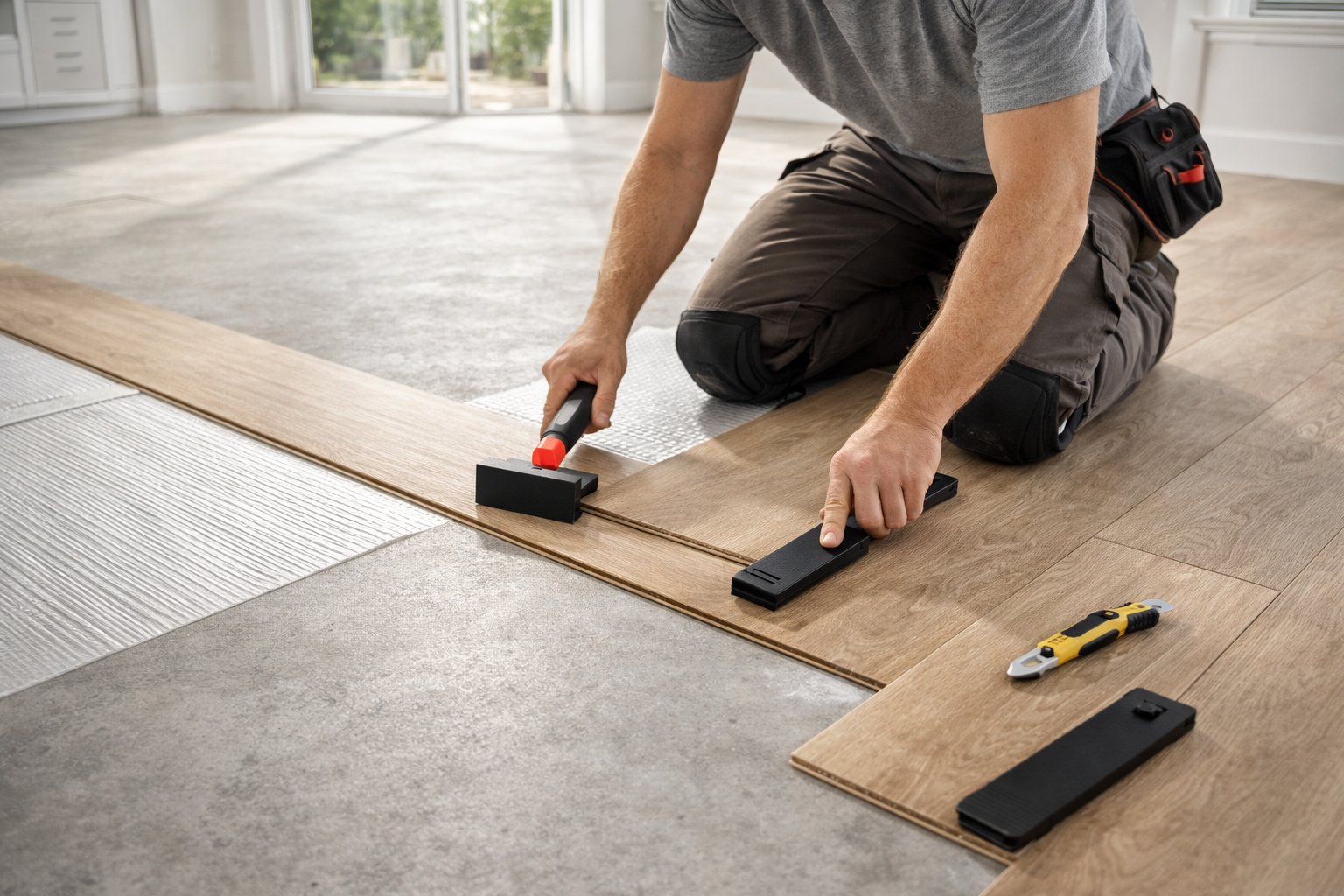
Luxury vinyl flooring has become a go-to choice for homes built on concrete slabs, especially across Southern California where slab foundations are common. It offers the look of wood or stone with added durability, moisture resistance, and comfort underfoot. However, installing luxury vinyl flooring over concrete is not a simple drop-and-lock job. The slab condition, moisture levels, and preparation steps all play a major role in how well the floor performs long-term. Getting these details right is what separates a floor that looks great for years from one that starts failing far too soon.
Concrete slabs and what lies beneath the surface
Concrete may look solid and dry, but it constantly interacts with moisture. Even older slabs can release moisture vapor that affects flooring materials placed above them. Unlike wood subfloors, concrete does not flex, which means any unevenness transfers directly to the vinyl planks or tiles.
Luxury vinyl is forgiving compared to hardwood, but it still requires a flat, stable surface. Skipping slab prep often leads to issues like plank separation, hollow sounds, adhesive failure, or visible telegraphing of imperfections through the floor.
Moisture testing before anything else
Before selecting an installation method, moisture testing should always come first. A slab that looks dry on the surface may still have elevated moisture emissions.
Common testing methods include calcium chloride tests and relative humidity probes. These results determine whether a moisture barrier is required and which type of luxury vinyl installation is appropriate. Ignoring this step is one of the most expensive mistakes made during slab installations.
Preparing the slab for success
Cleaning and removing surface contaminants
Concrete slabs must be free of dust, paint, sealers, curing compounds, and old adhesive residue. Even thin layers can interfere with proper bonding or locking systems. Mechanical grinding is often used to achieve a clean, porous surface that is ready for installation.
Addressing cracks and low spots
Hairline cracks are common and usually manageable, but structural cracks must be evaluated before proceeding. Low spots and dips are more critical than minor high points. Luxury vinyl flooring manufacturers typically require the slab to be flat within specific tolerances, often no more than 3/16 inch over 10 feet.
Self-leveling underlayments are frequently used to correct uneven areas and create a smooth, uniform surface that supports the vinyl properly.
Choosing the right luxury vinyl format
Not all luxury vinyl performs the same over concrete slabs. The choice between floating, glue-down, or rigid core products depends on slab conditions and room usage.
Floating click-lock vinyl works well when the slab is flat and moisture levels are controlled. Glue-down luxury vinyl is often preferred in large spaces, commercial areas, or rooms with heavy furniture, as it minimizes movement and expansion. Rigid core vinyl, such as SPC or WPC, provides added stability and helps bridge minor imperfections in the slab.
Each option has advantages, but the slab condition should always guide the decision rather than aesthetics alone.
Underlayment and vapor barriers explained
Some luxury vinyl products come with an attached pad, while others require a separate underlayment. When installing over concrete, a vapor barrier is often necessary even if the product includes padding.
Plastic sheeting or manufacturer-approved moisture membranes help block vapor transmission from the slab. Using the wrong underlayment or doubling up on padding can void warranties and cause locking failures, so manufacturer guidelines must be followed carefully.
Expansion gaps still matter on concrete
A common misconception is that expansion gaps are unnecessary on slab installations. While concrete does not expand like wood, luxury vinyl still reacts to temperature changes.
Perimeter expansion gaps allow the flooring to move naturally without buckling. These gaps are later covered by baseboards or molding, maintaining a clean finished look while protecting the floor’s integrity.
Installation timing and acclimation
Even though luxury vinyl is more dimensionally stable than many flooring materials, acclimation still matters. Planks or tiles should be brought into the space and allowed to adjust to room temperature before installation.
Installing vinyl in a space that is too cold or too warm can cause expansion or contraction issues later. Consistent indoor conditions during and after installation help ensure the floor performs as designed.
Avoiding common slab installation mistakes
Many installation problems trace back to rushed preparation or incorrect product pairing. Skipping moisture testing, installing over uneven slabs, using the wrong adhesive, or ignoring expansion gaps often leads to premature failure.
Professional installation brings experience in reading slab conditions and adjusting the installation method accordingly. This attention to detail protects both the floor and the manufacturer warranty.
A smart foundation for long-lasting floors
Installing luxury vinyl flooring over concrete slabs can deliver outstanding results when done correctly. With proper moisture management, slab preparation, product selection, and installation techniques, luxury vinyl becomes a durable, attractive solution for slab-built homes. The foundation may be concrete, but the success of the floor depends entirely on the steps taken above it.
Schedule expert flooring guidance in Santa Ana
At Avalon Wood Flooring, flooring experts bring over 60 years of combined industry experience to every project. Serving Santa Ana, Irvine, Newport Beach, Corona del Mar, and Fountain Valley, free in-home measurements and expert guidance help ensure luxury vinyl flooring is installed right from the start. Visit the showroom or schedule a consultation to explore one of Orange County’s largest flooring selections with confidence.

